
From luxury packaging to global regulations, this month’s Set in Stone® explores why material innovation is no longer defined by ideas alone, but by real-world applications, measurable data, and market validation.
Okeanos® Business Newsletter – July 2026
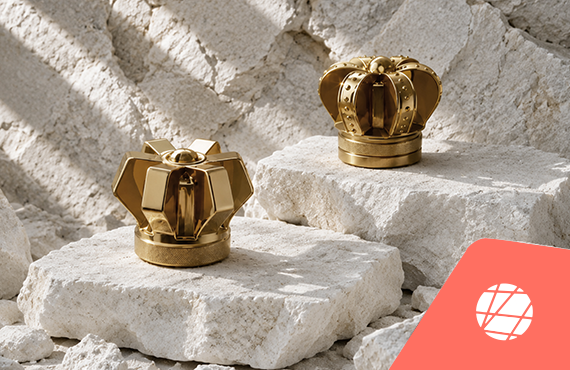
Luxury Packaging: When Materials Become Part of the Product Experience
Luxury packaging has always relied on weight, texture, and precision to communicate value before a product is even used. Traditionally, those qualities have depended on conventional plastics, decorative finishes, or heavier materials. But a new launch from Grupo Boticário suggests that material innovation can achieve the same objective, while delivering measurable environmental benefits.
Eudora Royal features the world’s first perfume caps produced with Made From Stone™. Developed through several years of collaboration between Grupo Boticário, Aptar Beauty, Okeanos, and the teams responsible for research, packaging development, and manufacturing, the project demonstrates how packaging materials can contribute directly to brand perception.
Rather than compromising the premium experience, Grupo Boticário chose to increase the cap’s density, creating a heavier feel that reinforces the sense of sophistication consumers associate with luxury products. This was a deliberate design choice, rather than an inherent property of the Made From Stone™ formulation.
As Franciele Saorin, Packaging Research Expert at Grupo Boticário, explained:
“This increase in mass transforms the consumer’s tactile perception, adding a sense of sophistication, solidity, and prestige that is directly associated with the luxury market.”
The launch illustrates a broader shift in packaging design. Material selection is no longer only about cost, manufacturability, or sustainability. Increasingly, it is becoming part of the product experience itself.
For brand owners, that creates a compelling opportunity: choosing materials that not only reduce plastic use but also strengthen the way consumers perceive quality, performance, and value.
Could your packaging material become part of the product experience?
Explore how Made From Stone™ can help create premium packaging with measurable impact.
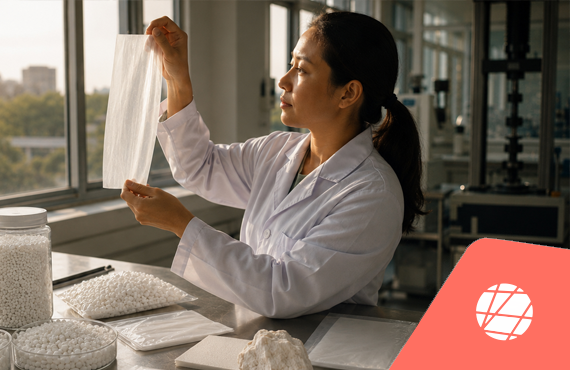
Why Asia-Pacific Is Leading the Next Generation of Packaging Materials
For decades, Asia-Pacific was recognized primarily as the world’s manufacturing hub. Today, it is becoming something even more significant: one of the fastest environments for developing, validating, and commercializing new packaging materials.
According to the World Bank, East Asia and the Pacific account for more than one-third of global manufacturing value added. That concentration of manufacturing capability, engineering expertise, and sophisticated supply chains allows new materials to move from laboratory concepts to commercial production at remarkable speed.
Across Japan, South Korea, and other regional markets, companies are increasingly seeking packaging solutions that can reduce plastic consumption without requiring new machinery or significant process changes. As regulatory expectations continue to evolve, manufacturers are prioritizing technologies that can be integrated into existing production infrastructure while delivering measurable environmental performance.
As Peter Park, Sales Manager at Okeanos Korea, recently noted in Plastic Korea:
“Don’t think of it as calcium carbonate added to plastic. Think of it as plastic acting as a binder for a mineral-based material.”
That perspective reflects a broader shift occurring across the region. Rather than simply improving conventional plastics, manufacturers are exploring fundamentally different approaches to material design that balance performance, commercial feasibility, and sustainability.
From Japan’s advanced manufacturing ecosystem to South Korea’s rapid pace of industrial innovation, Asia-Pacific is increasingly becoming one of the regions where the future of packaging materials is being shaped first.
Discover how global partnerships are accelerating material innovation across Asia-Pacific. Reach out to trade@madefromstone.com
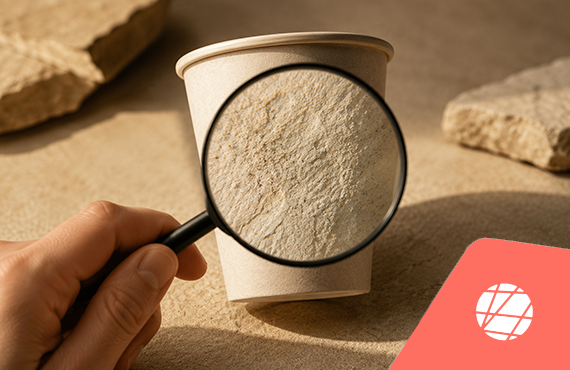
The Shift From Claims to Evidence
Not long ago, sustainability claims helped products stand out. Today, they are expected to withstand increasing scrutiny from regulators, retailers, investors, and consumers alike. Across global markets, the same question is being asked more frequently: Can you prove it?
In Europe, the Packaging and Packaging Waste Regulation (PPWR) is raising expectations around recyclability, material composition, and supporting documentation, while broader legislation is tightening the requirements for substantiating environmental claims.
In the United States, the FTC’s Green Guides continue to require that environmental marketing claims be supported by competent and reliable scientific evidence, making broad terms such as “green” or “eco-friendly” increasingly difficult to defend without verifiable data.
Across Latin America, countries including Chile, Colombia, and Brazil are expanding Extended Producer Responsibility (EPR) frameworks and strengthening packaging regulations. At the same time, manufacturers across Asia are facing growing customer and export-market expectations for traceability, lifecycle data, and documented environmental performance.
The direction is remarkably consistent regardless of geography: environmental claims are evolving from marketing messages into measurable business decisions.
Life Cycle Assessments (LCAs), verified carbon calculations, traceable supply chains, and documented material performance are no longer technical reports that remain behind the scenes. They are becoming strategic business assets that help companies build credibility, support customer decisions, and prepare for an increasingly regulated market. In this environment, sustainability is no longer measured by the strength of the message, but by the strength of the evidence behind it.
Explore how verified LCA data can strengthen your next packaging decision.

When the Container Becomes Part of the Story
In this article, Massimo Martinotti explores how packaging contributes to the narrative of a product, not simply as a container, but as an essential part of the meaning brands create.
Massimo Martinotti is the founder of Starlight Effect, a strategic narrative consultancy. Over more than thirty years, he has helped brands across thirty countries translate identity, culture, and ambition into meaningful narratives. Learn more about Massimo and his work.
In 331 BC, after defeating the Persian king Darius III, Alexander the Great’s army discovered an extraordinary golden chest among the possessions of the royal palace. Adorned with precious stones and pearls, it was considered one of the most magnificent objects in the Persian Empire.
His generals debated what could possibly deserve such a container. Alexander did not hesitate. He placed inside it what he considered the most valuable object in the world: his personal copy of Homer’s Iliad.
The choice changed both objects. The chest declared the importance of the story it held. The Iliad, in turn, transformed the chest from an expression of wealth into an object with purpose.
Gold, Persia, conquest, Achilles, heroism and destiny now belonged to the same construction of meaning. Container and content had become inseparable parts of one narrative. That ancient gesture offers a useful way to think about packaging.
A product’s narrative is not limited to advertising or what is written on its label. It is formed by the total system through which the product acquires identity and value: its name, origin, form, language, price, context, symbols, materials, and packaging.
Packaging belongs to that system. Its colors, typography, proportions, surfaces, weight, and construction are not merely external embellishments applied after the story has been defined. They are among the elements from which the story itself is made. Alter them and the product does not simply look different. It begins to mean something different. It tells a different story.
This is why materiality matters. Materials bring histories, associations and cultural codes into the narrative. Their texture, density, finish and durability contribute to the identity of the object and to the value attributed to it.
The same is true of structure. The way a container holds, reveals or protects what is inside establishes a relationship between the product and the person who encounters it. It can imply care, precision, abundance, restraint, permanence or fragility. Those meanings are not added through explanation. They are built into the object.
Packaging can also consecrate. It can declare that what it contains deserves attention, preservation or a particular kind of regard. This is what Alexander’s chest did for the Iliad. It did not invent the importance of the book. It made that importance physically present.
The relationship is reciprocal. The product gives the container its reason for existing; the container gives the product a material form consistent with the meaning the brand seeks to construct. When the two belong to the same narrative logic, each strengthens the other.
For brand strategists, this changes the role of packaging. It is not the final decorative layer of a product, nor merely a tactical execution. It is a narrative asset: one of the physical forms through which a brand becomes coherent, recognizable and valuable.
Alexander’s chest did more than hold the Iliad. It became part of the story, and changed it. That is what a container can do when it is conceived as part of the narrative from the beginning.

Rockstar of the Month
The people who power Okeanos.
Kiko Borger | Consumer Engagement Manager | São Paulo, BR
Kiko turns strategy into stories people actually care about. By connecting Made From Stone™ with consumer needs, culture, and creativity, he helps build a brand that makes sustainability easier to understand and harder to ignore.
His Impact: Builds the Made From Stone™ brand by connecting Okeanos’ solution with consumer needs, turning sustainability into stories people can understand, remember, and act on.
What his role makes possible at Okeanos
Brand value starts when people understand why something matters. Kiko helps translate Okeanos’ technology into consumer-facing stories that make the Made From Stone™ badge more meaningful, showing how better packaging choices can create real positive impact.
By connecting strategy, creativity, and culture, he helps bring Made From Stone™ closer to the people it was designed to reach.
What his role touches
- Build the Made From Stone™ brand through consumer engagement
- Translate complex sustainability topics into simple, memorable stories
- Connect strategy, creativity, and culture to create meaningful brand value
In Kiko’s words
What does your role enable at Okeanos?
As Consumer Engagement Manager, my mission is to build the Made From Stone brand by connecting Okeanos‘ solution with people’s needs. I help consumers understand why choosing packaging with our badge matters and the positive impact it can make. That’s how we create value for our product.
What’s something people don’t usually see?
People often assume creatives are driven by inspiration. I’m actually driven by structure. I love organizing chaos, connecting dots, and turning complex challenges into simple stories. Creativity comes after the strategy.
What motivates you?
Creating ideas that genuinely impact people, making them smile, laugh, think, or feel something. Even more so when those ideas help brands with a genuine purpose, create positive change in the world.
Outside work: I enjoy arts and sports. I love films, series, books, and great stories. I’m also passionate about sports. Running, football, tennis, and boxing are some of my favorites. Whether I’m playing or watching, sports are how I recharge.
Learn more about career opportunities at Okeanos.