
From textile waste to material performance and local production, this month’s Set in Stone® explores what the evidence can prove and how material innovation meets real-world demands.
Okeanos® Business Newsletter – October 2026
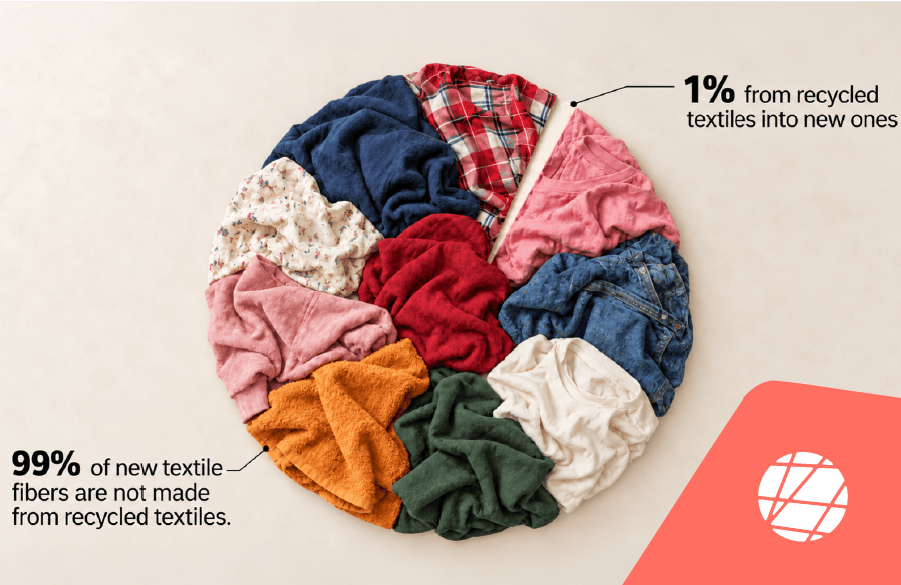
What Happens to the 99%
In Chile’s Atacama Desert, one of the driest places on Earth, mountains of discarded clothing now stretch across hundreds of hectares. Some of it gets burned in the open. Most of it will never be worn again.
The joint UNECE/ECLAC report behind this doesn’t put a precise number on it: several tens of thousands of tons of textile waste now cover roughly 300 hectares near Alto Hospicio, growing since 2012.
It’s not an isolated problem. UNEP puts global textile waste at 92 million metric tons a year. In 2023, only 8% of textile fibers came from recycled sources, and less than 1% came from recycling old textiles into new ones.
Those numbers say something recycling alone can’t fix: the world produces more material than reuse and recycling can ever absorb. Secondhand trade creates real economic value, but it can also just relocate the waste problem to places with the least capacity to handle it.
Recycling and reuse still matter. But they’re downstream fixes for an upstream problem. The more useful question isn’t “how do we recycle this better?” It’s “why does this need this much material in the first place?”
That’s the question packaging and manufacturing should be asking now. Not less material at any cost, but less material that still performs, still protects, still meets spec. The constraint isn’t ambition. It’s physics and production reality.
Once something becomes waste, recovering its value takes energy, infrastructure, and money of its own. The cheapest ton of waste to manage is the one that never gets made.
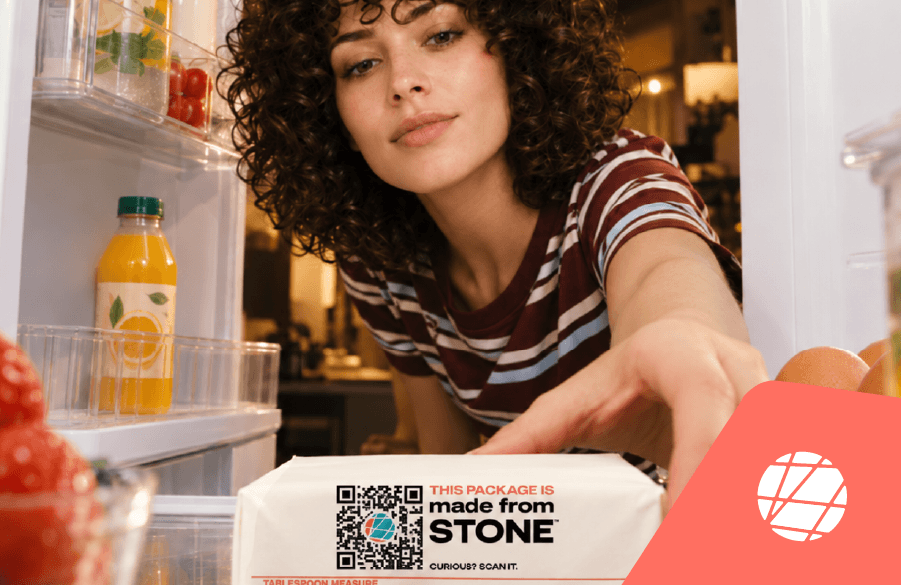
Butter Hasn’t Changed Much. Its Wrapper Can
Think about a butter wrapper. It’s a small piece of packaging, but it has a surprisingly demanding job. It needs to resist grease, hold its fold, protect the product, carry the brand’s identity, and run efficiently through production.
For manufacturers, changing that wrapper isn’t as simple as switching materials. A new solution still has to meet the application’s performance requirements and work with existing equipment. So what if we could change what the wrapper is made of, without changing the way it’s produced?
That’s the idea behind a butter-wrap application developed using Made From Stone™, Okeanos’ technology that incorporates high levels of calcium carbonate, a naturally occurring mineral, into polymer-based packaging.
The objective is to explore an alternative material approach to conventional waxed paper while addressing the performance and processing requirements of butter packaging.
Grease resistance is one of those requirements, alongside the ability to lie flat, retain a fold, and provide a printable surface for branding. These are practical considerations, not optional extras. A packaging material needs to meet the demands of its application before its environmental benefits become relevant.
Change the Material. Not the Production Line. The application is designed to be compatible with existing wrapping equipment, offering a potential route to material innovation without requiring a complete overhaul of the production process.
There’s also an opportunity beyond the production floor. With the Made From Stone™ badge and QR code, brands can communicate the material change and connect consumers to packaging-specific environmental information.
For manufacturers and brands exploring alternatives to conventional packaging materials, butter wraps offer a practical example of how material innovation can start with something remarkably ordinary.
Sometimes, the biggest opportunity isn’t to reinvent the package. It’s to rethink what it’s made of.
Could your packaging use a rethink? Talk to our team about your application.

Standards Aren’t Paperwork
Standards give materials a common benchmark for evaluation. Ray Loflin, Okeanos’ North America Sales Director, serves as Secretary of ASTM Subcommittee D20.96 and Chair of Section D20.96.14, bringing 14 years of experience in ASTM’s work on environmentally degradable plastics and biobased products.
A material changes under heat and humidity. How do you measure that change, compare results, and avoid drawing conclusions the test cannot support?
That is the role of ASTM D7444, a standard practice for evaluating the heat and humidity aging of oxidatively degradable plastics. Its reapproval keeps an established framework in place for comparing material behavior under defined laboratory conditions.
Ray Loflin, Okeanos’ North America Sales Director, has spent 14 years contributing to ASTM International’s work on environmentally degradable plastics and biobased products. He currently serves as Secretary of ASTM Subcommittee D20.96 and chairs Section D20.96.14.
The distinction worth keeping in mind: measuring degradation is not the same as proving biodegradation. D7444 helps evaluate changes in material properties under specified conditions. Its results cannot, on their own, predict what will happen in a real-world disposal environment.
Ray’s next focus is ASTM D7475, which evaluates aerobic degradation and anaerobic biodegradation under accelerated bioreactor landfill conditions. Even there, the scope matters: the test does not represent every type of landfill, and results must be interpreted within the conditions tested.
Standards don’t make the claim. They define what the evidence can support.
Explore the science behind material performance and our Bioterra-M™ line.
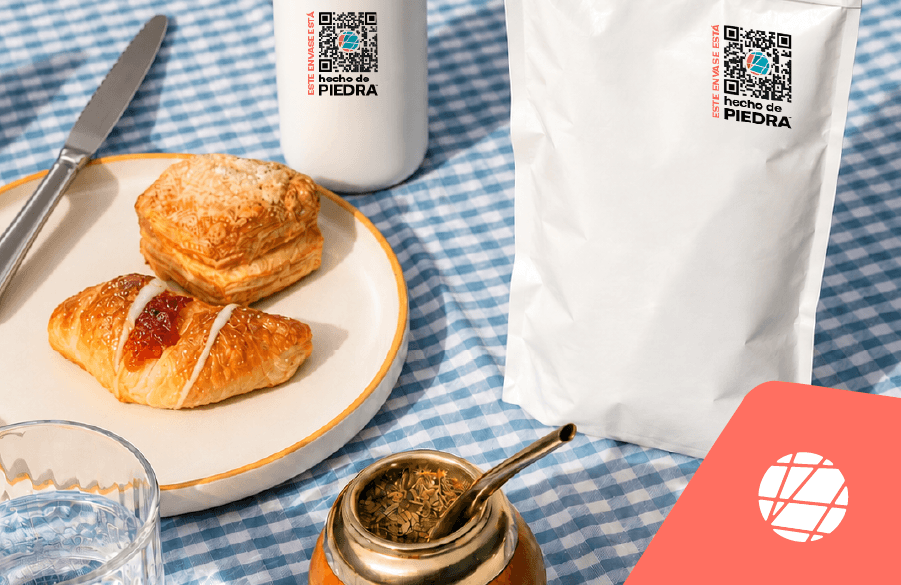
Made in Argentina
Expanding into a new market takes more than a proven formula. It takes the right partner to bring that formula into production.
Okeanos is partnering with Plastar Group to manufacture Made From Stone™ at Plastar’s facility in San Luis, Argentina, expanding its global manufacturing network.
With decades of experience in blown film manufacturing, Plastar brings established industrial expertise to the partnership. Okeanos will provide its proprietary formulations and oversee production under its quality standards, applying the same manufacturing model used across its global network.
Manufacturing in Argentina can shorten supply routes for regional customers and create opportunities to reduce transportation-related emissions compared with sourcing the material from abroad.
The partnership combines Okeanos’ material technology with Plastar’s manufacturing expertise to bring Made From Stone™ production closer to manufacturers in Argentina.
The technology is global. Now, production is closer to home.

Rockstar of the Month
The people who power Okeanos.
Keagan Adonis | Accountant | Cape Town, South Africa
Keagan looks beyond the numbers to make Okeanos’ financial operations work smarter. From improving reporting accuracy to rethinking everyday processes, he turns complex challenges into lasting business improvements.
His Impact: He improves financial processes and reporting accuracy by turning complex challenges into smarter systems and more efficient workflows.
What his role makes possible at Okeanos
Behind every reliable financial report is a system designed to make things work better. Keagan helps strengthen Okeanos’ financial operations by identifying opportunities for improvement, optimizing processes, and developing solutions that make reporting more accurate and teamwork more efficient.
By combining analytical thinking with creative problem-solving, he helps turn everyday challenges into long-term improvements for the business.
What his role touches
- Optimize financial systems and processes to improve efficiency
- Enhance reporting accuracy through targeted projects and improvements
- Develop practical solutions that strengthen workflows and team collaboration
In Keagan’s words
What does your role enable at Okeanos?
As a Project Accountant, I specialize in problem-solving and financial process improvement. I optimize core systems and lead targeted projects to enhance reporting accuracy, efficiency, and overall team workflow.
What’s something people don’t usually see?
A lot of planning, coordination, and strategic brainstorming happens behind the scenes. By thinking outside standard paradigms, we ensure we build and deliver the best possible solutions for the business.
What motivates you?
My motivation stems from my family. Every day, I’m reminded of how blessed I am to have an amazing wife and, now, a baby on the way! The strength, purpose, and support they give me drive everything I do and inspire me to continuously strive for excellence in my career.
Outside work: My main focus outside of work is my church music ministry – serving as the pianist is a huge calling for me and where I invest a lot of my heart and energy. When I’m not behind the keyboard, I love relaxing at home with my wife and keeping our cat entertained! I also enjoy competitive gaming and picking up a padel racket every now and then for a fun, competitive match.
Learn more about career opportunities at Okeanos.