
May 2026
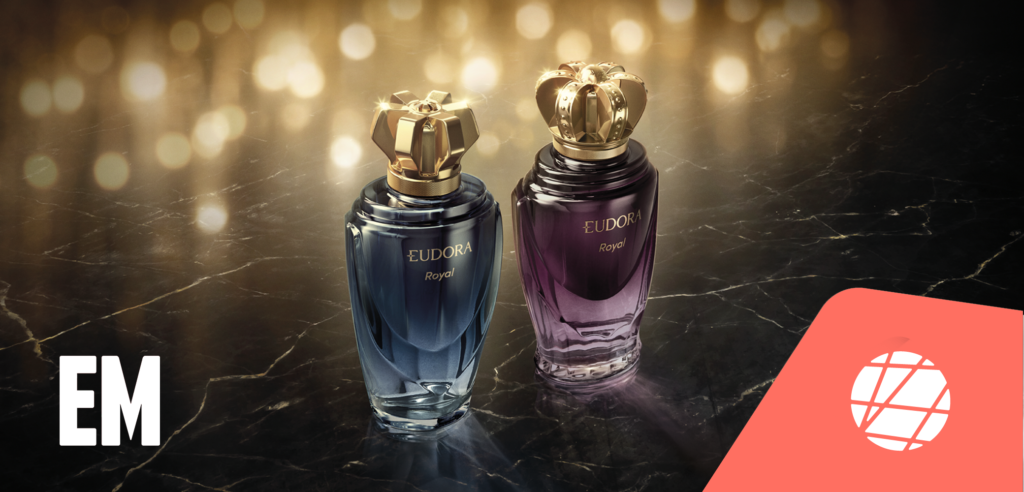
June 29, 2026 – The search for packaging materials that reduce costs and environmental impact is constant. Numerous research initiatives are underway, but not all prove commercially viable—either because they lack competitive pricing or cannot scale. Some, however, are succeeding. In a first-of-its-kind move, Grupo Boticário has adopted a material commercially known as Made From Stone™ (MFS) for the caps of both the men’s and women’s Eudora Royal fragrances. These are officially the first perfume caps in the world produced using this material.
Developed by Okeanos, which has filed a patent application for the technology, Made From Stone™ is a compound made primarily from calcium carbonate, one of the world’s most abundant minerals, found in limestone, chalk, and rocks—hence the name. The material can replace a significant portion of conventional plastic in polypropylene (PP) and polyethylene (PE) applications, delivering both technical and economic benefits.
Cap Produced Using Overmolding Technology
The Royal caps are manufactured using overmolding technology in a single, highly efficient production cycle. The closure’s core is injection molded with 100% Made From Stone™, serving as an intelligent ballast that takes advantage of calcium carbonate’s high density to concentrate weight at the component’s center of gravity.
The outer shell is then overmolded using a polypropylene blend containing 75% Made From Stone™, creating a component that combines precise dimensional stability with substantial weight, delivering a premium tactile experience associated with luxury packaging.
“Our first contact with Okeanos was in 2020 through our research team, with the goal of expanding our portfolio of sustainable materials,” recalls Franciele Saorin, Packaging Research Expert at Grupo Boticário.
“After two intensive years of joint testing with Aptar Beauty, the component manufacturer, we developed several resin formulations using Made From Stone™. In 2022, the technology became available to our product development teams, who, together with our marketing department, identified opportunities to incorporate it into our products.”
According to Marcelo Cunha, Business Development Manager at Okeanos Brazil, Made From Stone™ offers advantages across multiple dimensions. “Calcium carbonate is one of the most abundant minerals on Earth and is available on every continent,” he explains. “Because of its natural abundance, it is far less exposed to the supply constraints and price volatility that affect plastics derived from oil and natural gas.”
According to the company, the material costs 10% to 20% less per kilogram than conventional plastic, depending on the application and formulation. During manufacturing, Made From Stone™ is incorporated into the formulation to replace a portion of conventional plastic. It is compatible with the three primary plastic processing technologies used in packaging—injection molding, extrusion, and blow molding.
The percentage of mineral content is adjusted according to the product’s functional requirements while maintaining the necessary mechanical, aesthetic, and performance characteristics.
“The finished packaging delivers the same performance as conventional plastic without compromising quality, and the material requires no modifications to existing processing equipment,” Cunha explains.
He also notes measurable manufacturing benefits. “Calcium carbonate transfers heat more efficiently than plastic, allowing the material to heat up and cool down more quickly during processing. As a result, cycle times are reduced, along with energy consumption per kilogram of packaging produced.”
Cunha adds that Made From Stone™ is manufactured in Brazil and that local production is a strategic priority. “We manufacture close to our customers through a global network of production facilities across five continents. This shortens supply chains, reduces transportation emissions, and supports local economies.”
Made From Stone™ can be blended with the most common packaging plastics, including virgin and post-consumer recycled (PCR) polyethylene (PE) and polypropylene (PP). The material can also be formulated for recyclability within existing polyolefin recycling streams.
“This is a deliberate design choice made during formulation and manufacturing, tailored to both the application and the recycling infrastructure available in the target market,” Cunha says.
Grupo Boticário reports positive results with the technology. “We’re successfully combining the best of both worlds,” says Franciele Saorin. “While polypropylene provides the structural flexibility, impact resistance, and dimensional stability required for the cap’s closing performance, incorporating the mineral content of Made From Stone™ significantly enhances these properties.”
According to Saorin, the resulting compound has a substantially higher density, producing a heavier cap with a more robust physical presence. “This increase in mass transforms the consumer’s tactile perception, adding a sense of sophistication, solidity, and prestige that is directly associated with the luxury market,” she concludes.
The following is a direct quote from the original article published in Portuguese here.