
This month’s Set in Stone® examines three forces reshaping packaging: claims, compliance, and the industry’s biggest bet on paper. What survives when proof becomes the standard?
Okeanos® Business Newsletter – June 2026
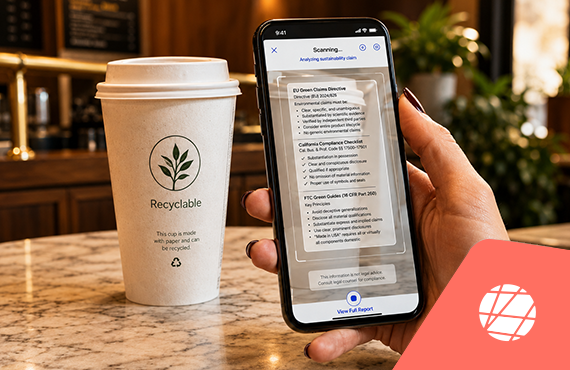
The End of Sustainability Claims as We Know Them
For a decade, sustainability claims lived on the front of the pack. “Recyclable.” “Plant-based.” “Eco-friendly.” None of them legally tested. That window is closing.
The EU’s Green Claims Directive sets evidence standards for environmental claims. The PPWR ties recyclability claims to design-for-recycling assessments. California’s SB 343 makes false recyclability labeling a violation under state truth-in-advertising law. The US PACK Act is coming for the same language federally.
The shift is from descriptive to evidentiary. “Recyclable” used to be an aspiration. Now it has to be backed by an assessment in the jurisdiction. “Recycled content” needs chain-of-custody documentation. “Lower carbon” needs a published LCA.
The claim and the proof now ship together. Or the claim doesn’t ship at all.
Most brands built their packaging stories before either was true. The ones rewriting them now aren’t the loudest. They’re the ones whose story survives the audit.
Made From Stone™ was built for this. Up to 60% less virgin plastic. The chain of custody is short and documented. The claim and the proof are the same thing.
Our sustainability and legislation teams get the support materials and our in-house marketing team builds the story around it; artwork, messaging, the QR code that takes the customer from the package to the proof.
Talk to us about what your packaging can actually claim.

The Industry’s Biggest Bet Might Be Wrong
Half of Amazon’s shipments, the largest e-commerce operation in the world, now move in flexibles instead of boxes. Pregis built a 477,000-square-foot mailer facility to keep up. Mondi opened Pittsburgh. Georgia-Pacific hit 3 billion EarthKraft mailers. TemperPack launched WaveKraft.
The format shift is settled. The box is losing to the mailer. What the mailer is made of isn’t settled.
Right now the industry has one answer: fiber. Every major converter is investing in paper capacity. Every retailer scorecard rewards the switch. Sustainability in e-commerce has been reduced to a single decision: go paper.
When everyone makes the same move at once, no one is differentiated.
And the assumption underneath it hasn’t been audited. Paper production is water- and energy-intensive. Wet-strength treatments complicate recycling. Fiber mailers don’t match poly on barrier or durability in many use cases. None of it is hidden. It’s just not being asked.
Stone-based film is a different premise. Made on existing blown film lines, with up to 60% less virgin plastic, from a short and documented supply chain.
Made From Stone™ runs across every layer of the unboxing. Mailer, bottle, cap, insert. One material decision, end to end. Our in-house team builds the artwork, the story, and the QR code that links the box in their hand to the proof behind it.
The format question is closed. The material question is wide open.
See what your unboxing could be made of. Reach out to trade@madefromstone.com

The Packaging Deadline Most Brands Are Still Underestimating
August 12, 2026. The EU Packaging and Packaging Waste Regulation (PPWR) starts to apply across every member state. From day one: a PFAS ban on food-contact packaging, declarations of conformity, and packaging-minimization rules. Then, rolling out through 2030: recyclability grades, reuse targets, deposit-return systems, and stronger EPR rules.
The EU’s PPWR doesn’t sit alone. In the US, seven states have passed packaging EPR laws, with the earliest programs already in force. The UK is invoicing producers and can impose court fines with no upper limit. Canada has it across nine provinces. Colombia, Chile, India, Vietnam — all live, all expanding.
The pattern is the same everywhere. Register. Report what you ship. Pay fees that scale with weight and recyclability. The data goes into public databases.
Packaging isn’t a sustainability initiative anymore. It’s a compliance category. Closer to financial reporting than to marketing.
Wherever the deadline lands, the brands filing cleanly aren’t the ones with the best ESG reports. They’re the ones with the simplest packaging stack.
Made From Stone™ simplifies the stack. Up to 60% less virgin plastic. One material, one chain of custody, fewer lines on the compliance report.
See how Made From Stone™ files cleanly. Get in touch with us.
The Alignment Tax: The Cost No Brand Budgets For
In this article, Massimo Martinotti introduces the concept of the Alignment Tax: the hidden cost organizations pay when what they communicate outpaces what they can sustain internally.
Massimo Martinotti is the founder of Starlight Effect, a strategic narrative consultancy. Over more than thirty years, he has helped brands across thirty countries translate identity, culture, and ambition into meaningful narratives.
There is a hidden tax that modern brands are paying without noticing. It doesn’t go to the government; it’s paid in internal friction, legal reviews, and ignored marketing. Let’s call it the Alignment Tax.
Many organizations don’t pay this tax because they lack good intentions. They pay it because what they communicate, what they do, and what they believe are not fully aligned.
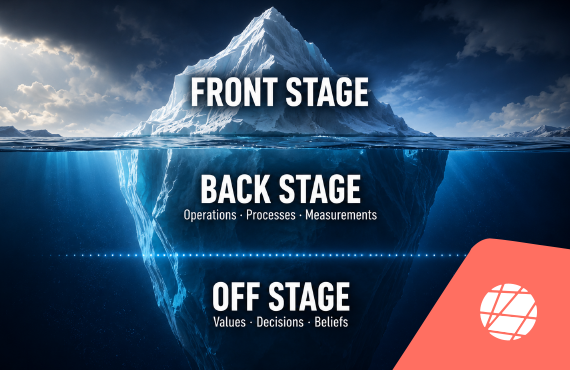
This misalignment appears across three planes:
Off Stage: what the organization believes, prioritizes, and is willing to decide.
Back Stage: what it actually does, measures, incentivizes, and transforms.
Front Stage: what it communicates to the market.
A brand is exposed when the Front Stage promises more than the Back Stage can prove. Progress fails to translate into perceived value when the Back Stage moves forward without a clear narrative defined Off Stage. And without clear Off Stage criteria, every department ends up building its own version of sustainability.
Brands came to the language of recyclability, circularity, low emissions, and sustainability through pressure, trends, and corporate mimicry. Suspicion of greenwashing, new regulatory demands, more skeptical consumers, more vigilant investors, and employees increasingly unwilling to tolerate contradictions between purpose and practice all contributed to this shift.
In response, many organizations adopted the expected vocabulary: recyclable, circular, low-impact, carbon-neutral, responsible, sustainable. Correct words. Safe words. Words that seem to reduce risk. But also words everyone else is using.
That is where the first cost appears: homogeneity.
Brands enter the conversation to protect themselves, but end up funding campaigns, reports, packaging, presentations, and content built around language the market has already heard too many times. Money is invested in communication that does not register, does not differentiate, and, in the worst cases, begins to feel false precisely because it sounds so familiar.
The second cost is more serious: a generic narrative can become harmful.
It becomes harmful when an organization speaks in a language it has not yet earned. When the environmental promise is larger than the evidence. When public discourse moves faster than strategy, culture, and operations.
That is when the company begins to pay, often without noticing it, a hidden tax that quietly confiscates value.
This tax is paid every time the absence of a coherent narrative forces the organization to compensate with more validations, more caution, more explanations, and more defensiveness. Communications, sustainability, legal, operations, and leadership work from different criteria. A campaign requires endless reviews because no one knows exactly what can be promised. A report says something operations cannot yet support. An environmental statement opens a new front of scrutiny instead of building trust.
The cost is not limited to reputational risk. It is the internal energy consumed by trying to align late what should have been aligned from the beginning. It is slower decision-making, loss of clarity, and the growing difficulty of converting genuine efforts into perceived value.
To matter, concepts such as recyclability, circularity, low emissions, and sustainability must first live Off Stage, where they become filters for decision-making and criteria for managing tensions.
Sustainable differentiation begins when a brand stops repeating category language and starts demonstrating its own criteria.
Those criteria show up in what the company measures, changes, and is willing to abandon, as well as in the tensions it makes visible and the commitments it can sustain under scrutiny.
At that point, evidence stops functioning as defense and starts building the brand. Closing that distance is an act of governance: aligning the Off Stage first, so the Back Stage has direction and the Front Stage has something real to defend.
In an environment saturated with similar promises, what will define a brand is its ability to reduce the distance between what it says, what it does, and what it can sustain under pressure. That distance is the real tax.

Rockstar of the Month
The people who power Okeanos.
Lucila Carbone | Accounting Analyst | Buenos Aires
Lucila helps turn financial data into clarity. Through reviews, reconciliations, and treasury support, she keeps Okeanos’ financial information accurate, reliable, and ready for confident decision-making.
Her Impact: She helps keep Okeanos’ financial information accurate, reliable, and ready to support decision-making.
What her role makes possible at Okeanos
Good decisions need solid information behind them. Lucila helps consolidate financial data at the end of each month, supporting the delivery of accurate company results and keeping treasury operations running with clarity and control.
Her work helps ensure Okeanos can understand its financial performance, plan responsibly, and make decisions with confidence.
What her role touches
- Consolidate monthly financial information for company results
- Support treasury operations and financial controls
- Review data through reconciliations and analysis to ensure accuracy
In Lucila’s words
What does your role enable at Okeanos?
As an Accounting and Treasury Analyst, my role helps consolidate all the financial information at the end of each month to deliver the company’s financial results. I also support treasury operations, ensuring that our financial information is accurate and reliable for decision-making.
What’s something people don’t usually see?
A lot of the work happens behind the scenes. Before the financial results are presented, there are many reviews, reconciliations, and analyses to make sure the information is accurate and trustworthy.
What motivates you?
I’m motivated by the opportunity to keep growing professionally, learn something new every day, and apply the knowledge I gained through my accounting degree in my work.
Outside work: My dream is to visit as many countries as possible and experience different cultures. I enjoy traveling because it allows me to learn new ways of life, broaden my perspective, and meet people from different backgrounds.
Learn more about career opportunities at Okeanos.