
This month’s Set in Stone® is about not choosing. How a brand changed what it’s made of without changing what it’s known for, and why most never try.
Okeanos® Business Newsletter – May 2026
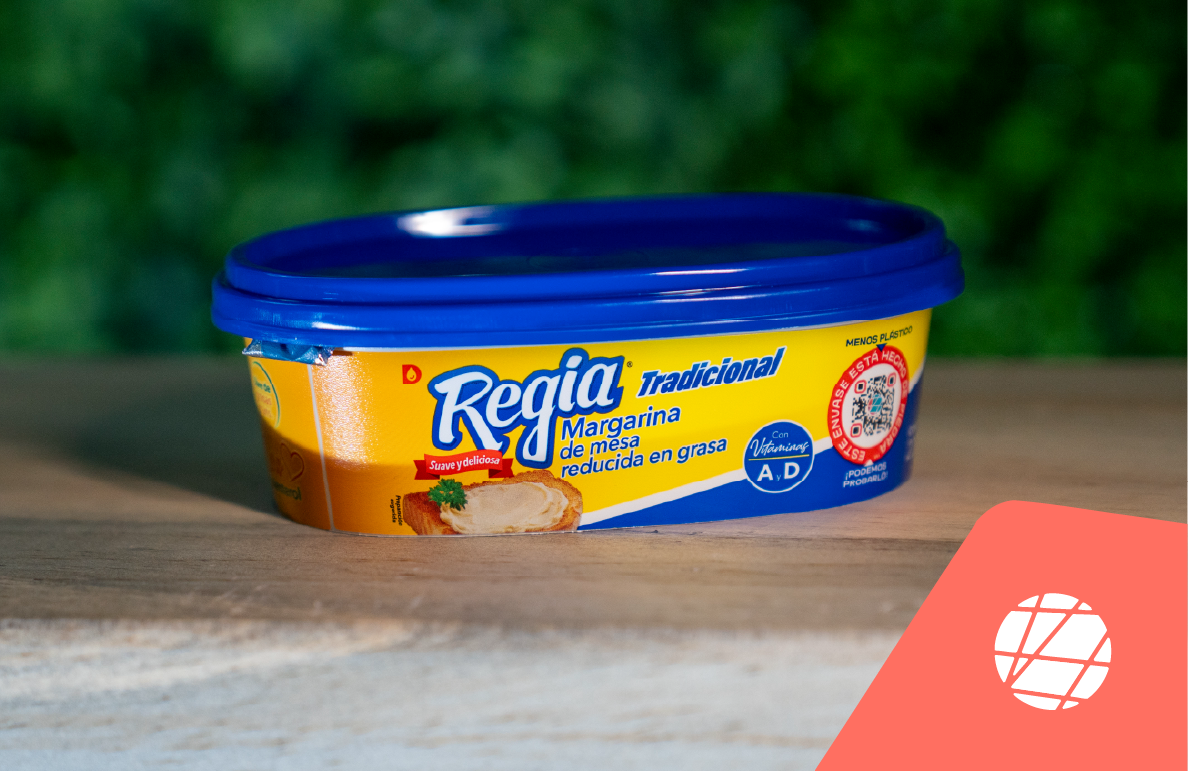
Same Brand. Same Tub. Less Plastic.
The hardest promise in sustainable packaging is the one that sounds too good to be true. Cut the plastic, keep the product exactly the same, and don’t raise the price. Grupo Danec says it did all three with Regia margarine, a brand that has been in Ecuadorian kitchens for generations. We sat down with Regia and Empaqplast for an interview on how the switch to Okeanos®’s Made From Stone™ technology was actually done.
A cut of up to 30% in plastic. What did it take on the line? No new machinery. Empaqplast’s existing converter built Made From Stone™ into the material formulation and ran the tubs on the same injection lines, with only adjustments to process parameters. The reduction reaches up to 30% depending on the format, the carbon footprint drops with it, and the tub stays recyclable. The line that made the old package makes the new one.
Sustainability usually costs more. Why didn’t the shelf price move? It didn’t move because it was never meant to. Regia reached every channel with no increase in retail price, since the whole initiative was built so the consumer would not pay for it. There is a longer-term angle too. Virgin resin prices swing hard and often. An abundant mineral input does not. That trade favors cost stability, and in a margin-thin category, stability is what procurement actually loses sleep over.
What can consumers see for themselves? A QR code on every pack. It opens the product’s life cycle analysis, including its plastic reduction and carbon footprint. Regia’s reasoning is simple. If you are going to make a sustainability claim, put the information where the consumer can reach it, at the moment they decide.
Does changing the pack put a trusted brand’s base at risk? That was the one line the project would not cross. The product inside is the same. Same taste, same creaminess, same quality, validated through testing under real production conditions. A brand families have bought for decades changed what the package is made of without asking anyone to accept a different product. Nobody has to choose between the margarine they trust and the one that uses less plastic, because they are the same tub.
Curious what this would mean for your packaging? Get in touch with us.
From Pilot to Production: What a Brand Can Actually Stand Behind
Across climate tech and materials, pilots are everywhere. Scaled adoption is not.
Over the past year, that gap has become harder to ignore. Refill programs tested well but struggled to expand. Advanced recycling pilots made headlines but failed to deliver reliable supply. Even materials that performed in trials often stalled once asked to run day after day, across multiple facilities.
For a brand, that gap is not just an operational problem. It’s a credibility problem. A pilot makes a promise. Production is what keeps it. The distance between the two is exactly where brand trust is won or lost.
That’s because pilot success is a weak signal of scalability. Technical validation shows a material can work. Operational adoption shows that it does, consistently, repeatedly, and without special handling. A brand can only claim what its supply chain can actually sustain.
The real test comes after the pilot:
- Can it run on existing equipment without retooling?
- Does performance hold at commercial volumes?
- Can the same specifications work across regions and formats?
- Does it integrate into existing procurement and quality systems?
This is where many promising technologies slow down, and where many brand claims quietly outrun what the material can deliver.
Materials that scale don’t announce themselves loudly. They show up consistently, across lines, regions, and formats. So do the brands built on them.
That’s where Okeanos works: in production, at scale, under real operating conditions. The place where a claim stops being a campaign and becomes something a brand can stand behind.
Make a claim your supply chain can keep. Reach out to trade@madefromstone.com
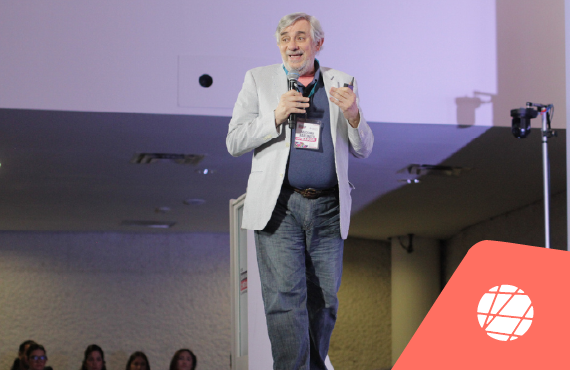
Variations of the Same Narrative
Why ambitious brands end up sounding like everyone else, and what it takes to stop.
In this article, Massimo Martinotti explores why sustainability messaging across categories increasingly converges, and why real differentiation starts from a different premise.
Massimo Martinotti is the founder of Starlight Effect, a strategic narrative consultancy. Over more than thirty years, he has helped brands across thirty countries translate identity, culture, and ambition into meaningful narratives.
Most brands flatter themselves with the illusion of a singular, distinctive narrative.
In truth, they are often rehearsing subtle variations on a handful of shared scripts. Examine any category where the stakes are high, whether pharmaceutical, automotive, finance, or technology, and the pattern becomes evident: eight or ten heavyweights, supported by massive budgets, near-universal awareness, and generations of equity, crowded into the same conceptual territory. Their surface aesthetics differ, yet the underlying narrative architecture reveals a striking convergence.
When you systematically map a category’s narrative terrain, its dominant archetypes, plots, emotional territories, value systems, and semiotic codes, you typically discover intense clustering around a few well-trodden zones. The periphery, by contrast, remains strangely quiet. These unclaimed spaces are not empty by accident. They exist because the prevailing category logic renders them invisible, implausible or strategically uncomfortable. They represent genuine white space for any brand courageous enough to operate from a fundamentally different premise. This is the territory we illuminate through what we call the Edge Index. The Edge Index is structured in three interdependent layers that together reveal both the constraints and the opportunities hidden in plain sight.
The Field is the occupied ground. It shows what competitors have already claimed, what the category has already saturated, and where any new claim would simply be absorbed as another variation of the familiar. It is the space where brands may appear different on the surface while still playing the same game in different jerseys.
The Edge is the available ground: the territory that has not been claimed or exhausted by the category, but that a brand can still occupy with credibility. Not every empty space is strategically useful. Some spaces remain empty because they are irrelevant, implausible or dangerous. A territory only becomes an Edge when it creates separation from the Field while connecting to something the organization can genuinely support: its history, capabilities, culture, ambition, behavior or point of view.
The Drift is the invisible force that eventually pulls almost every ambitious brand back toward the center. It rarely arrives as a dramatic crisis. Instead, it operates through the slow accumulation of ordinary business pressures: AI tools trained on existing category patterns, optimization engines that reward what has already been validated, short-term volume demands, risk-averse cultures that quietly penalize deviation, and the natural human tendency to seek comfort in the familiar. Many brands launch with genuine edge, only to find themselves, a few cycles later, sounding increasingly interchangeable with their competitors. The Drift is patient, structural, and merciless.
Understanding these three layers allows a brand to see where the category is crowded, where credible territory still exists, and what forces will try to pull it back to the center.
Differentiation then becomes more than a matter of creative intuition. It becomes the discipline of understanding the gravitational pull of a category and deciding with precision where not to belong.
Trust Doesn’t Break. It Erodes.
Sustainability promises rarely break in the open. They erode. A target slips a year. A figure picks up a footnote. “By 2025” becomes “by 2030,” and because nothing was ever announced, the assumption inside the company is that nothing was noticed.
It was noticed. Not the way brands measure it. Consumers don’t read sustainability reports or track restated targets. They carry a rougher and more durable instrument: a slowly updating sense of whether a brand is the kind that means what it says. Every quiet retreat feeds that instrument. None of it registers in the quarter it happens. All of it registers eventually.
A brand doesn’t lose trust the moment it breaks a promise. It loses it slowly, then all at once.
This is the most underpriced risk in branding. The cost of the sustainable material gets modeled carefully. The cost of announcing a commitment and quietly stepping back from it rarely does, because it arrives late and lands where the spreadsheet isn’t looking.
We’ve already seen brands delay recycled content targets, refill programs, and carbon reduction timelines once operational complexity appears. They make commitments they can keep under bad conditions, not just good ones. A smaller promise kept outperforms a larger one walked back, because the customer is keeping score on exactly that.
The market has a short memory. The people a brand sells to don’t. That is the part worth settling before a launch, not after. A commitment isn’t the thing a brand announces. It’s the thing it still stands behind the quarter it gets expensive. Everything else is a campaign with a sustainability budget.
A promise is only worth what a brand can keep. Build sustainability commitments your operations can actually sustain: trade@madefromstone.com

Rockstar of the Month
The people who power Okeanos.
Miguel Martínez | Sales Associate, LATAM | Quito
Miguel helps customers see sustainability as a business advantage, not a trade-off. Through deep listening, trust-building, and practical solutions, he turns commercial conversations into packaging choices with real impact.
His Impact: He helps customers across LATAM find sustainable packaging alternatives that make business sense, without compromising performance or profitability.
What his role makes possible at Okeanos
Commercial growth starts with trust. Miguel works closely with customers to understand their real needs, constraints, and opportunities, helping them move away from conventional materials and toward solutions that are better for business and better for the planet. By connecting sustainability with performance and profitability, he helps turn better packaging choices into a competitive advantage.
What his role touches
- Listen deeply to customer needs, constraints, and business goals
- Connect clients with sustainable alternatives that fit their operations
- Build trust that helps turn commercial conversations into long-term change
In Miguel’s words
What does your role enable at Okeanos?
My role connects clients with sustainable alternatives that actually make business sense. I help them transition away from conventional materials without sacrificing performance or profitability. By understanding their needs deeply, I open doors to solutions they didn’t know existed, turning sustainability from a cost into a competitive advantage.
What’s something people don’t usually see?
The amount of listening involved. Before proposing anything, I spend significant time understanding a client’s real constraints — operational, financial, cultural). Most people see the final recommendation; they don’t see the research, the rejected options, or the quiet work of building trust that makes a client actually willing to change.
What motivates you?
Knowing that a conversation I had today might eliminate thousands of plastic units tomorrow. Small commercial decisions may have a domino effect. I’m motivated by being at that intersection — where business meets responsibility — and proving that choosing better doesn’t mean choosing harder.
Outside work: I value a quiet, unpretentious life. No big ambitions to perform or impress — just the satisfaction of using my hands and mind to build things: a small project, a meal, a well-tended space. Creativity without an audience. That simplicity recharges everything else.
Learn more about career opportunities at Okeanos.