
This month’s Set in Stone® explores a simple reality: behind most packaging sits resin, and behind resin sits oil. What happens upstream doesn’t stay there, it directly impacts costs, planning, and profitability. A structural dependency brands can’t ignore.
Okeanos® Business Newsletter – March 2026
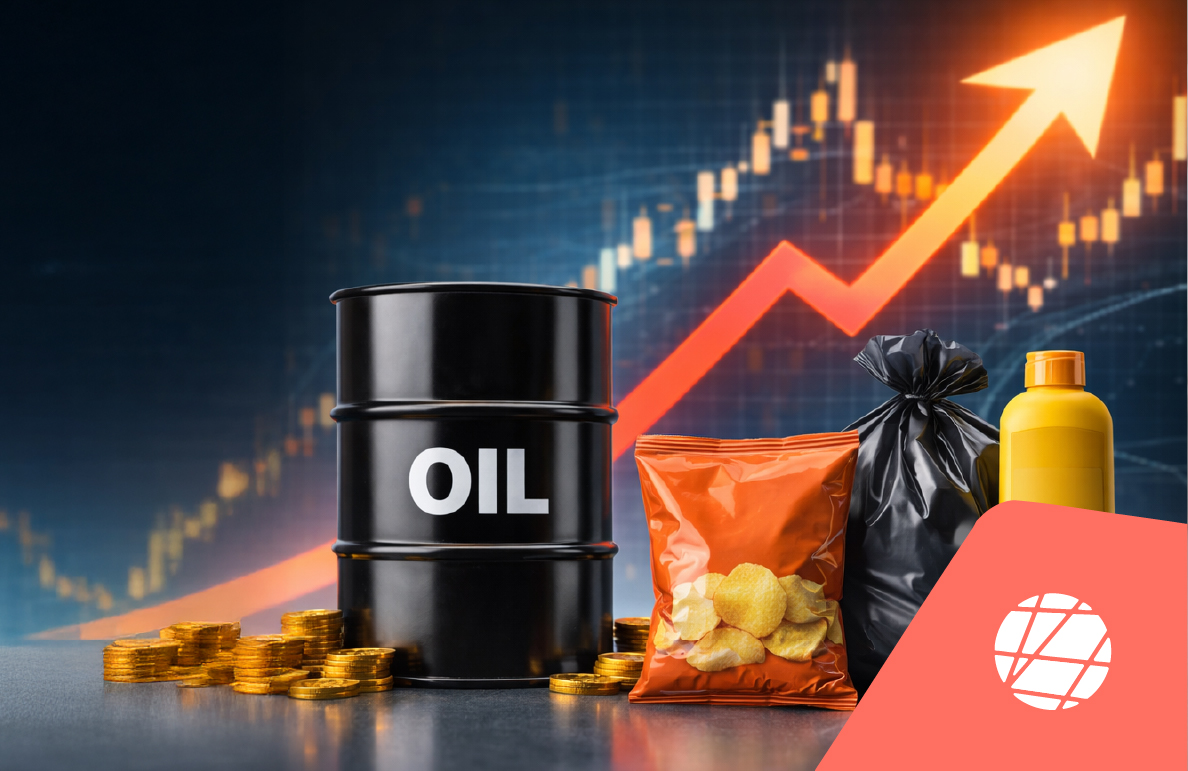
The Hidden Risk in Packaging: Resin Dependency
Most people think oil shows up in packaging through transport and energy. In reality, it sits inside the material itself.
Plastic resins are derived from petrochemicals. So when oil moves, packaging costs and supply move with it. Recent events have made that clear. Winter Storm Uri took a large share of U.S. resin production offline in days. Ongoing tensions around the Strait of Hormuz are putting a critical portion of global oil supply at risk, with direct impact on petrochemical markets.
This is how packaging risk shows up: fast, upstream, and outside your control. Because the issue isn’t demand. It’s dependency. That’s why packaging is becoming a sourcing decision, not just a cost one.
Materials that incorporate abundant minerals like calcium carbonate reduce reliance on petrochemical inputs without changing how packaging runs.
With 14 global plants, Made From Stone™ adds flexibility where traditional supply chains are most exposed.
Because the real question is no longer just what your packaging is made of but what your costs depend on.
Assess your packaging dependency risk.
The water footprint of packaging: What most people don’t see.
When we think about sustainable packaging, we tend to focus on carbon, recyclability, or compostability. But water, one of our most finite and essential resources, rarely gets the same attention, despite being critical to human survival, agriculture, industry, and ecosystem health. In a world where many regions already face water scarcity, overlooking water in sustainability decisions means missing a key part of the picture.
From production to disposal, packaging carries a hidden water footprint. The manufacturing of virgin plastic resins and many bioplastics can be water-intensive, requiring significant volumes for cooling, chemical processing, polymerization, and feedstock cultivation. Made From Stone™, which incorporates calcium carbonate, requires significantly less water for extraction and processing, offering a more water-efficient alternative, with impacts quantified through Life Cycle Assessments.
Our name, Okeanos®, is inspired by the Greek god of the oceans, a reminder of how central water is to everything we do.
If you’re interested in reducing your packaging’s water footprint reach out to trade@madefromstone.com
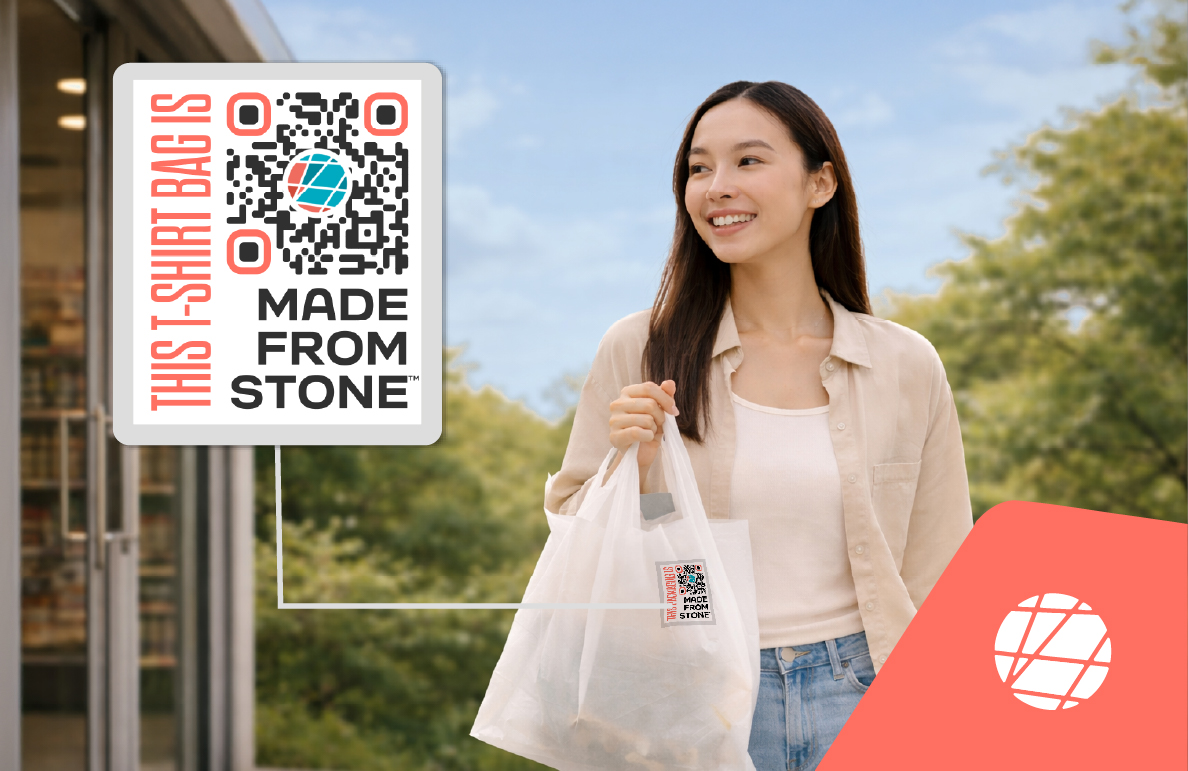
Packaging Is Gaining a Digital Layer
For years, packaging kept its materials hidden. Now, that is starting to change.
Pick up any product. Turn it over. What do you actually know about the packaging in your hands?
Probably very little. And until recently, there was no easy way to find out.
That is changing. A simple QR code, already on millions of products, can now open something entirely new. Not a website. Not a promotion. The actual story of the material: what it is made of, where it comes from, how much plastic it replaces, what CO₂ impact it carries.
In seconds. From the packaging itself. This is what the digital layer of packaging makes possible. The gap between what brands claim and what anyone can actually verify has never been wider. Most material innovation never reaches the person holding the product. It stays in a press release or a sustainability report that nobody reads.
The QR code closes that gap. It turns a physical object into something you can interrogate. And it turns a brand’s material choices into something, real, visible, and verifiable.
Made From Stone™ brings this to life through co-branded packaging and a QR experience that reveals the material behind the product, including plastic reduction and CO₂ impact.
No more claims. Something you can actually see.
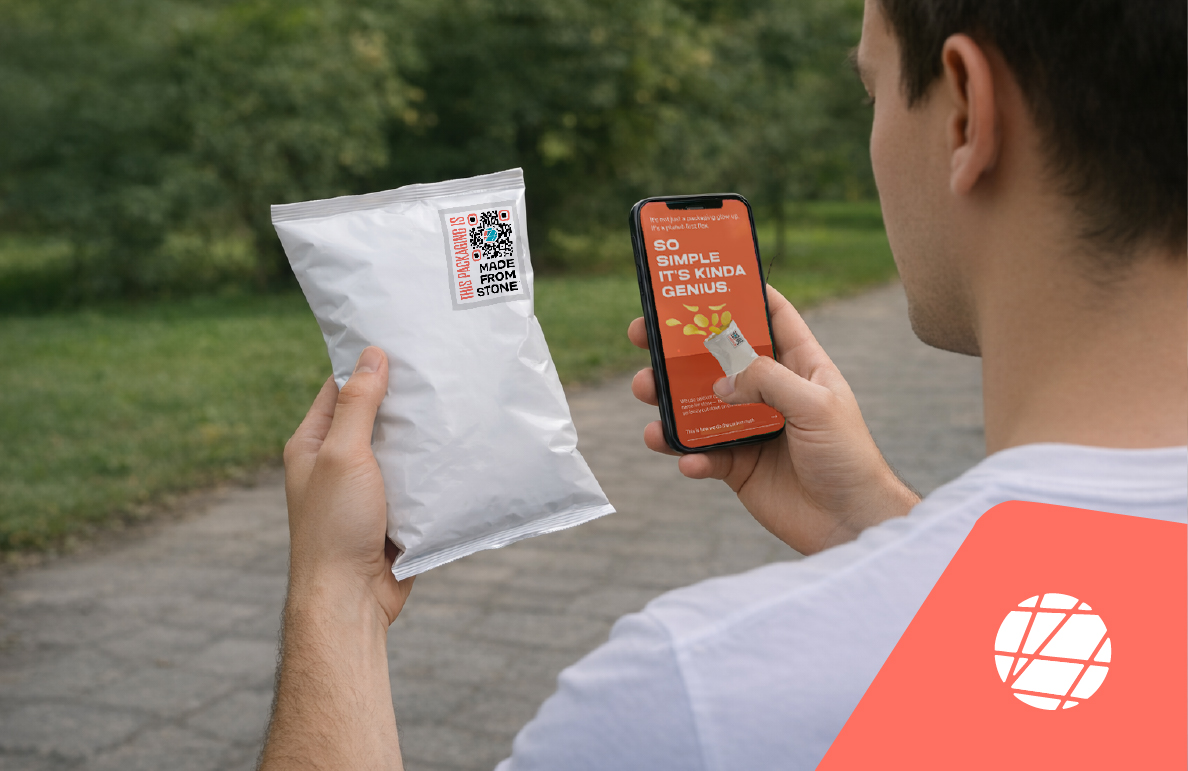
The Black Box of Packaging Is Opening
For decades, packaging has functioned as something of a black box.
Consumers interact with it every day, opening it, carrying it, throwing it away, yet rarely know what materials it is made from or where those materials come from. The focus has traditionally been on the product inside. Packaging itself has been largely invisible, discussed mainly by engineers, converters, and procurement teams behind the scenes.
But that dynamic is beginning to change. Across industries, transparency is becoming a new expectation. Consumers are increasingly curious about the environmental impact of the products they buy, and that curiosity is starting to extend to packaging materials as well.
As a result, packaging is slowly moving out of the black box. Several developments are driving this shift. First, brands are beginning to communicate more openly about packaging materials, highlighting recycled content, alternative materials, and carbon footprint reductions. What was once a purely technical decision is becoming part of the brand narrative.
Second, digital tools are transforming how packaging can communicate. QR codes, for example, allow brands to provide far more information than a traditional label ever could. With a quick scan, consumers can learn about the materials used, how packaging was produced, and even the environmental impact associated with it.
Third, regulatory and market pressures are encouraging greater material disclosure. Around the world, governments and retailers are asking companies to be more transparent about packaging composition, recyclability, and environmental performance.
Together, these forces are opening the black box of packaging materials. For converters and brand owners, this shift represents both a challenge and an opportunity.
Materials are no longer purely a technical choice made behind the scenes. Increasingly, they are becoming part of how brands communicate innovation, responsibility, and progress.
As packaging becomes more transparent, the materials behind it will matter more, not only for performance and cost, but also for the story they tell.
Let’s make your packaging more transparent: trade@madefromstone.com

Rockstar of the Month
The people who power Okeanos.
Agnese Medina | Supply Chain Analyst | Buenos Aires
This Women’s Month, meet Agnese: she keeps the supply chain moving when plans don’t. From supplier follow-ups to last-minute fixes, she turns unexpected challenges into smoother deliveries, stronger coordination, and smarter processes for the future.
Her Impact: She keeps production and deliveries running smoothly by coordinating orders and communication across suppliers, customers, and internal teams.
What her role makes possible at Okeanos
To mark Women’s Month and celebrate women in STEM and operations, we’re highlighting Agnese. She helps ensure orders move forward with clarity and speed, aligning supply chain details behind the scenes so customers get what they need, when they need it, even when plans change.
What her role touches
- Coordinate orders and timelines across suppliers and customers
- Solve delivery and production issues through constant follow-up and internal alignment
- Improve processes by learning from what didn’t go as planned
In Agnese’s words
What does your role enable at Okeanos?
It helps coordinate orders and communication with suppliers and customers, ensuring production and deliveries run smoothly for our customers.
What’s something people don’t usually see?
The constant follow-up and internal coordination required to solve problems and manage unexpected situations behind the scenes.
What motivates you?
I’m motivated by the energy that comes with solving unexpected challenges. When things don’t go as planned, I see it as an opportunity to learn, understand what went wrong, and improve the process for the future.
Outside work: I love cooking and I’m really interested in nutrition. In my free time, I enjoy the gym, spending time with friends, and doing puzzles. One of my dreams is to open a gluten-free specialty coffee café one day.
Learn more about career opportunities at Okeanos.